
1. QUANTITATIVE ANALYSIS
The documentary film Poisoned: The Dirty Truth About Your Food, examines the food industry in the United States, and systemic fractures resulting in outbreaks of foodborne pathogens.
One can argue to little objections that food is perhaps the greatest pleasure of being human. We owe the developments of our civilization to the improvements in the food that we consume. Yet it often slips people’s minds that basic human need is also a double-edged sword, perfectly capable of the widespread destruction of mankind.
This article explores some of the challenges to food safety in Ghana Africa, and provides a case study of how successfully HACCP implementation can act as a solution.
The National Food Safety Policy for Ghana has the ultimate aim of establishing and maintaining an integrated farm-to-fork food safety system that ensures consumer health and public safety.
Everyone within the food chain has a responsibility to ensure that food is safe and suitable by adopting and implementing food safety management systems that align with the policy.
Challenges in Ghana’s hospitality sector
Looking at Ghana’s hospitality sector, food safety is a critical concern for the various establishments within the sector such as hotels, restaurants, catering services, and food vendors. They all play a significant role in ensuring the safety of the food they serve, as it directly impacts not only public health but also their establishments’ reputation. However, the sector faces several challenges that hinder the achievement of optimal food safety standards.
One of the key challenges faced by Ghana’s hospitality sector is the lack of robust enforcement of existing regulations and guidelines. While Ghana has regulatory frameworks in place, such as its National Food Safety Policy, their implementation, and monitoring often fall short due to, among many other factors, a lack of political will and coordination between relevant authorities [Citation Min22 \l 17417].
Lack of compliance
Insufficient inspections and limited penalties for non-compliance contribute to a lax food safety
culture within the sector. If left unchecked, this culture would then allow food safety issues to manifest rampantly within the hospitality sector.
Street food vendors
A study by King, Awumbila, Canacoo, and Ofosu-Amaah found that only 1.85% of the Ghana street food vendors surveyed met basic hygiene requirements based on five criteria:
1. Presence of animals
2. covered waste containers
3. Licensed meat sources
4. Food protection from dust and flies
5. Vicinity to a drain/toilet/refuse dump (2000).
While these unsanitary practices can be traced back to a lack of awareness amongst the vendors, they are in business for profit and will probably ignore ethics.
Foodborne diseases
Outbreaks of foodborne illnesses not only pose risks to public health but can also lead to reputational damage and financial losses for establishments.
An establishment worth noting here is the government of Ghana itself, which incurred an annual loss of USD 69 million in its fight against foodborne diseases [Citation Mah12 \l 17417].
News of food poisoning incidents spreads rapidly through social media and word-of-mouth, causing potential customers to question the safety standards of hospitality establishments. This highlights the urgent need to enhance food safety practices and regain consumer trust.
HACCP – The solution
One of the most promising solutions to the problem at hand is the implementation of the Hazard Analysis Critical Control Points (HACCP) management system.
Initially developed during the 1960s, HACCP focuses on identifying, evaluating, and controlling hazards during the food production process based on seven principles as listed by the US Food and Drug Administration (FDA):
1. Conduct a hazard analysis
2. Determine the critical control points (CCPs)
3. Establish critical limits
4. Establish monitoring procedures
5. Establish corrective actions
6. Establish verification procedures
7. Establish record-keeping and documentation procedures.
Fundamentally, HACCP is not used enough in Ghana, with 68% of hospitality employees in managerial roles around Kumasi a city in Ghana having the view that it is not mandatory (Agyei-Baffour et al., 2013).
While it may not yet be a legal requirement, HACCP execution will allow for Ghanaian food practices to be comparable to those of its international counterparts.
In brief, HACCP is a proactive solution to food safety problems and their attendant consequences, one that is contingent on addressing food safety constraints in Ghana.
There is little existing literature in Ghana providing evidence on how HACCP can improve a food service’s monitoring and evaluation performance, which may contribute to its lack of implementation.
This article effectively combats this, as a private food safety consultancy called Prime Occupational Health and Safety (OHS) joins the battle to save lives through innovation and science.
Currently, various scientific organisations have endorsed and recommended using the HACCP system. The US FDA did so back in 1999 due to its proven record of being “the most effective and efficient way to ensure that food products are safe” [Citation FDA15 \l 17417].
More than 10 years prior to the FDA recommendation, WHO EUROPE and the National Academy of Science already concluded that HACCP is worthy of being implemented to ensure food safety [Citation Wei18 \l 17417].
2. QUALITATIVE ANALYSIS
The Safe Skill Program
In 2023, Prime OHS developed a service product called the “Safe Skill Program” which envisions zero foodborne illness cases from the hospitality sector through compliance, training, and inspection.
Dstrkt 24 Management, a leading organisation within the sector, was the first to partner with Prime OHS and implement the Safe Skill Program in their two restaurants in Accra. Both of these establishments were already adhering to the Ghana FDA Code of Practice and other local regulations.
To enhance their environmental, social, and governance obligations and attract more financial investment, Dstrkt 24 Management went beyond local regulations and implemented HACCP through the Safe Skill Program.
Prime OHS established and implemented prerequisite programmes, including three months of weekly inspections to evaluate various food safety criteria such as supplier control, chemical control, pest control, personal hygiene, and sanitation.
Their performance data throughout the period are shown in Figure 1.
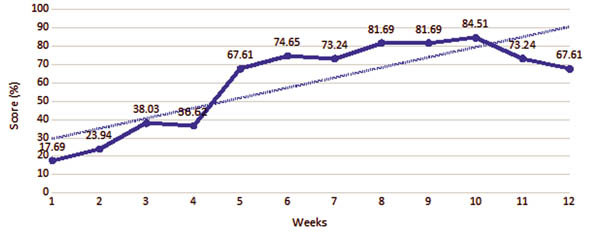
The performance data indicated a positive correlation between the duration of the Safe Skill Program implementation and the restaurants’ inspection scores.
To confirm the statistical significance of this correlation, a linear regression t-test was conducted at a 1% (0.01) significance level. The test hypotheses are stated below:
Null hypothesis (Ho): No linear correlation exists between the programme duration and the inspection scores.
Alternative hypothesis (H1): A linear correlation exists between the programme duration and the inspection scores.
The output from Excel’s Data Analysis feature is shown in Table 1.
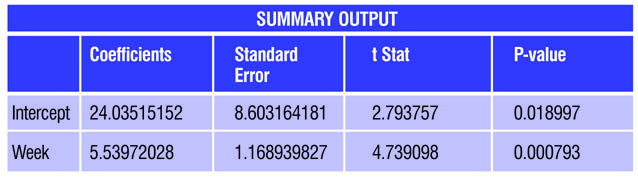
Since the p-value for “Week” (0.000793) is less than the significance level (0.01), there is sufficient evidence to reject Ho. Therefore, it can be concluded with high confidence that there is a significant linear correlation between the programme duration and the restaurant’s inspection scores – in other words, the longer the Safe Skill Program is implemented, the higher the restaurant’s inspection score will be.
This correlation can be attributed to the implementation of HACCP principles by Prime OHS.
Their team of qualified HACCP-certified experts can make a thorough analysis of potential hazards (Principle 1) that might be present in the restaurant’s food production chain, as well as the critical control points (Principle 2) for these hazards.
The analysis is especially helpful for the restaurant owners to identify hazards that are often overlooked due to a lack of food-safety expertise, and subsequently identify corrective measures (Principle 5) for the critical control points to bring the hazard below the established critical limits (Principle 3).
Monitoring procedures (Principle 4) in the form of weekly inspections were conducted, and inspection scores served as part of the record-keeping procedures (Principle 7).
Compliance with HACCP standards led to increased scores, hence verifying the restaurants’ adherence to food safety practices (Principle 6).
Interestingly, during weeks 4, 7, and especially the last 2 weekly kitchen inspections (weeks 11 and 12), the restaurant’s scores deviated from the general increasing trend and instead showed a decrease. This inadvertently demonstrates one of Prime OHS’ core values: transparency.
As an advisory consultancy, Prime OHS acts as an advisor in food safety matters for its clients, but whether the clients wish to make a consistent effort to comply is beyond the company’s control. Nevertheless, Prime OHS remains committed to its due responsibility to report any incompliance with full honesty and transparency, ensuring accountability for both parties and prioritising the best interests of end-consumers.
Prime OHS urges other stakeholders in the hospitality sector to become a member of the Safe Skill Program and save lives through innovation and science.
3. References
Agyei-Baffour, P., Sekyere, K.B. & Addy, E.A., Policy on Hazard Analysis and Critical Control Point (HACCP) and adherence to food preparation guidelines: a cross-sectional survey of stakeholders in food service in Kumasi, Ghana, BMC Res Notes, 6, 442 (2013), accessed 8th July 2023, https://doi.org/10.1186/1756-0500-6-442
FDA. (2015). FDA 1999 Food Code – Annex 5: HACCP Guidelines. Retrieved June 30, 2023, from U.S. Food and Drug Administration Web Site: https://wayback.archive-it.org/7993/20170406184821/https://www.fda.gov/Food/GuidanceRegulation/RetailFoodProtection/FoodCode/ucm054672.htm
King, L. K., Awumbila, B., Canacoo, E. A., & Ofosu-Amaah, S. (2000). An assessment of the safety of street foods in the Ga district, of Ghana; implications for the spread of zoonoses. Acta Tropica(76), 39-43. doi:10.1016/s0001-706x(00)00087-5
Mahami, T., & Odonkor, S. T. (2012, May). Food Safety Risks Associated with Tertiary Students in Self-Catering Hostels in Accra, Ghana. International Journal of Biology, Pharmacy, and Allied Sciences, 1(4), 537-550. Retrieved June 28, 2023, from https://www.researchgate.net/profile/Tahiru-Mahami/publication/259472039_Food_Safety_Risks_associated_with_tertiary_students_in_selfcatering_hostels_in_Accra_Ghana/links/5554b73408ae6943a871ac4e/Food-Safety-Risis-Associated-With-Tertiary-Students-Iin_selfc
Ministry of Health, Republic of Ghana. (2022). National Food Safety Policy. Accra: Ministry of Health, Republic of Ghana. Retrieved June 29, 2023, from https://www.moh.gov.gh/wp-content/uploads/2022/07/NFSP-Document-signed-and-launched.pdf
Weinroth, M. D., Belk, A. D., & Belk, K. E. (2018, August 30). History, development, and current status of food safety systems worldwide. Animal Frontiers, 8(4), 9-15. doi:10.1093/af/vfy016
NOTICES
1. Prime OHS Research Article contains preliminary material and research results and is circulated in order to stimulate discussion and critical comment.
Any opinions stated herein are those of the author(s) and are not necessarily representative of or endorsed by Prime OHS.
2. Copyright remains with the authors. The authors are free to proceed, without further Prime OHS permission, to publish this paper, or any revised version of it, in outlets such as journals, books, and other publications.
Visit:
or email:
Authors
Matthew Kwaw – Principal Investigator

Eric Adarkwa – Field Inspector
Maya Mehrotra – Research Personnel
Muhammad Afiq Amiruddin – Research Personnel
Prime Occupational Health and Safety Ltd. Food Safety Division