

Compiled by Innocent Bhaikwa, Fabian Buckley and Warren Manning
I. Introduction
Occupational Health and Safety (OHS) as a practice is of paramount importance in ensuring that employee Right to Health Care and Human Dignity are realised. The professionalisation of OHS practitioners is a critical step towards achieving this goal since competent OHS Practitioners are at the coal-face of OHS service provision. This position paper explores a proposed model of professionalisation in the field of OHS in South Africa.
II. Background
South Africa, like many other countries, faces numerous workplace safety and health challenges across various industries. The importance of OHS practitioners in addressing these challenges cannot be overstated. However, the field lacks a standardised professional framework, resulting in varied levels of competence and inconsistent practices.
III. The Need for Professionalisation
The needs for professionalisation is well established and includes :
1. Standardisation: Professionalisation would establish standardised qualifications, training, and certification requirements for OHS practitioners, ensuring a consistent and high level of competence.
2. Protection of Workers: A professionalised OHS workforce can better protect the health and safety of workers by the provision of high quality OHS services.
3. Legal Compliance: It would enhance compliance with existing OHS legislation and international standards, ensuring that South Africa aligns with global good practice.
IV. Benefits of Professionalisation
The well-know benefits have been stated before and includes:
1. Improved Workplace Safety: A professional OHS workforce can implement effective safety programmes, leading to reduced workplace accidents and health hazards.
2. Enhanced Productivity: Safer workplaces lead to increased productivity,
benefiting both employees and employers.
3. Public Confidence: Professionalisation builds public trust in OHS practitioners, ensuring that their advice and actions are reliable.
4. Economic Impact: Fewer accidents and healthier workers contribute to reduced healthcare costs and an overall boost to the economy.
V. The Current Status of OHS in South Africa
The proposed OHS professionalization project will need to overcome two serious challenges. The first is the fragmentation of OHS practice due legislation and the second is the lack of recognition of OHS practitioners
THE LEGISLATIVE FRAGMENTATION
South African OHS law is highly fragmented and has been so for over the last 40 years, as commented on by Ncube and Kanda (2018). They explained that these fragmentations have been resulting in duplication of law enforcement roles; a costly waste of scarce resources; and inconsistencies and lack of uniformity in the implementation of enforcement functions. The main outcome is a hampering of progress at safeguarding workers’ health.
The Benjamin and Greef Committee of Inquiry into a National Occupational Health and Safety Council in South Africa was presented to the Minister of Labour on the 29th May 1997 noted that “the practice of OHS across industries in South Africa is uncoordinated, fragmented and a burden on resources.”
Further analysis of the legislative framework shows that there are four departments (labour, mining, transport and health) creating OHS legislation and five regulatory bodies (aviation, rail, road, nuclear, maritime) creating specific OHS management protocols.
While the there has been progress in many technical aspects of OHS in South Africa the lack of coordination remains and if proposed amendments to the OHS Act are implemented, the fragmentation will in fact increase.
LACK OF RECOGNITION OF OHS PRACTICE
There is a persistent lack of recognition of OHS as a practice in South Africa. In all forms of health care analysis and planning including grand legislative proposals such as National Health Insurance , the role of OHS practitioners is consistently omitted.
This “unremembering” of OHS practitioners occurs even after the important role OHS practitioners have played in the responses to HIV/Aids, TB and Covid-19.
VI. Proposed Model
The proposed model is based on the understanding that OHS is a specialisation in the field of Public Health and that OHS practitioners are classified as “Health Professionals” by the International Labour Organisation (ILO) in its International Standard Classification of Occupations (ISCO) see table below:
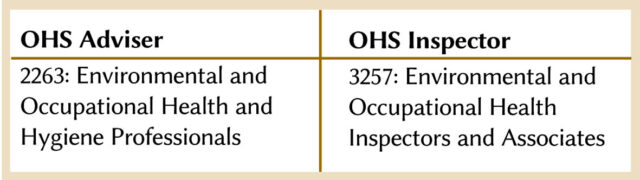
This necessarily means that OHS practitioners should be incorporated into statutory structure of the Health Professions Council of South Africa (HPCSA).
The HPCSA has 12 Professional Boards under its ambit and they are established to provide for control over the education, training and registration for Health professionals registered under the Health Professions Act.
THE WAY FORWARD
1. Consultation
All persons currently practising OHS within South Africa must be given the opportunity to comment on this position paper. A committee representing OHS practitioners will need to be established with the mandate to approach the respective Departments with our intention to be fully recognised as a profession.
2. Establish Professional Board under the HPCSA
The necessary consultation with the HPCSA will be conducted to identify all legal procedures to be followed for the incorporations of OHS into an existing Professional Board or for the establishment of an new independent OHS Board under the HPCSA.
3. Accredited Training Programmes
The status quo will respect to current qualifications of the practising OHS professionals will be established.
A process to develop accredited training programmes and institutions to ensure OHS practitioners receive the necessary education will be initiated.
4. Certification and Licensing
A system of certification and licensing will be established to verify the competence of OHS practitioners. This system will be built on the current certification practices of the HPCSA.
A transition arrangement will be determined to ensure fairness and inclusivity during a set period leading to mandatory professional registration.
5. Continuous Professional Development
As with all HPCSA professional a system of ongoing learning and professional development through mandatory continuous education requirements will be implemented.
Recognition of prior learning will be an essential component of this process.
VII. Conclusion
The professionalisation of OHS practitioners in South Africa is a vital step towards achieving safer workplaces and protecting the well-being of the workforce. It not only benefits workers but also contributes to economic growth and global competitiveness.
By implementing standardised qualifications, certification, and ethical guidelines, South Africa can elevate its OHS standards and ensure a safer, more productive future for all.
This position paper calls on OHS Practitioners, government bodies, industry stakeholders (especially labour unions), and educational institutions to collaborate in realising the professionalisation of Occupational Health and Safety practitioners for the benefit of South Africa’s workforce and economy.
The authors make a specific request to all OHS Practitioners in South Africa to critically reflect on this proposed way forward and send their comments and suggestions to us at:
Innocent: innocentbhaikwa@gmail.com
Fabian: Fabian.Buckley@Worley.com
Warren: warrengmanning@gmail.com
or
Safety First Magazine: debbie@safety1st.co.za